hkk.fyi

Everything
is a wave.

Electromagnetic waves are what pull me in — the way they radiate, guide, and interfere. I chase them across the spectrum: microwave circuits and antennas on one side, photonics on the other. Same physics, different wavelengths.

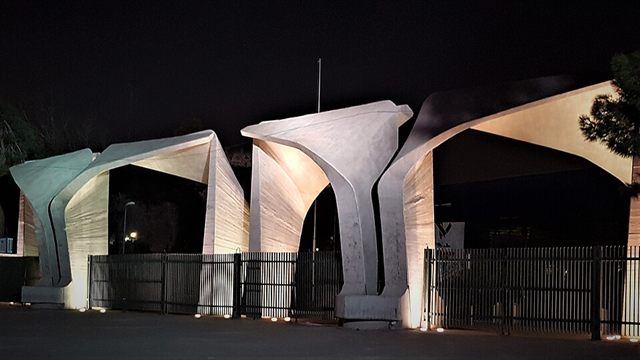
EE undergraduate at the University of Tehran; my thesis aims those waves at non-invasive deep brain stimulation. The details live in the CV — the instruments run live in the Lab.

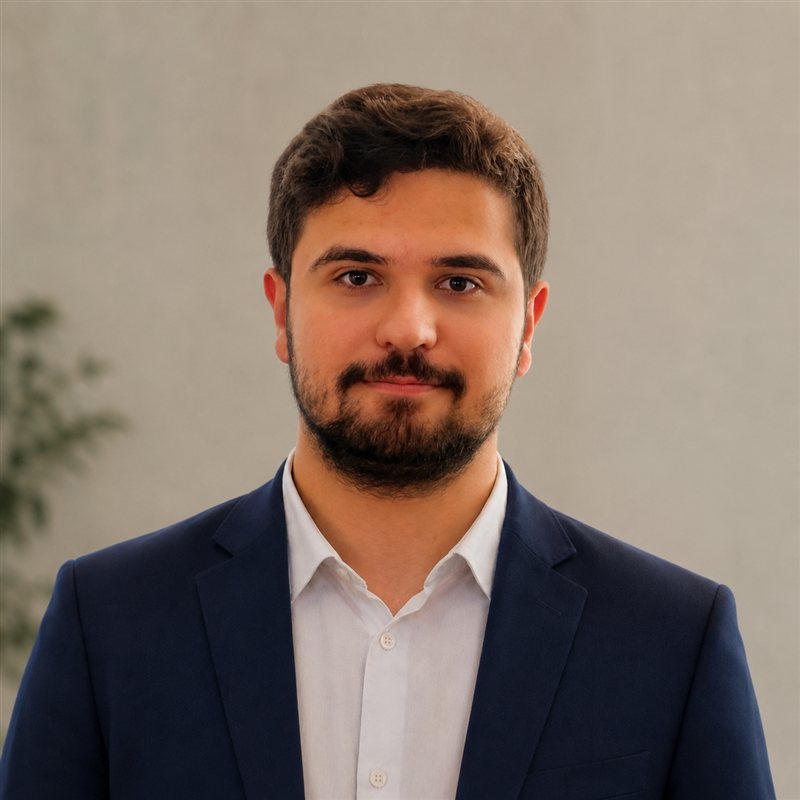
Hassan Keshtkar
HASSAN KESHTKAR · TEHRAN

01 Lab

Instruments I've built. They aren't screenshots — everything here runs live, in this page, offline-capable, no frameworks.

Smith Chart Studio

RF · canvas · teaching tool · 0 dependencies

A full interactive Smith chart with a built-in tutor. Drag the reflection point and watch Z, Γ, SWR and return loss stay in sync; rotate along a transmission line; flip impedance/admittance grids — then work through seven guided lessons, from “what is this chart” to L-network matching.

And if you want the story rather than the tool: Folding infinity into a circle is an essay on where the chart came from — a bored Bell Labs engineer in 1929, an infinite plane folded down to the size of a coin, and why software never managed to kill it. Seven live figures, no RF background needed.

PM-TI — the pitch

bioelectromagnetics · B.Sc. thesis · ICEE 2026 · 0 dependencies

My thesis in five minutes, told as a scroll: a brain that misfires, deep brain stimulation, the surgery it costs, temporal interference from the scalp, and why its hotspot is too wide — then PM-TI, our fix: one carrier, opposite phase modulation, and one knob k that cuts the hotspot width by two thirds in simulation and by more than half on the bench, without a single new electrode.

Every map and waveform is computed live from the thesis FEM export and the 70 mm saline phantom I scanned on the bench — drag k, sweep along x, and compare the simulation with the 7×7 pixel measurement. Arrow keys step through it like slides.

Open in new tab ↗

NEXT INSTRUMENT

On the bench. This slot is reserved — the lab is never finished.

02 Writing

Long essays on the things I keep circling back to. Same rule as the Lab — every figure is live and you can break it, nothing here is a screenshot.

FM Modulation 2026

ESSAY · SIGNALS & COMMUNICATION · ~15 MIN · 7 LIVE FIGURES

An FM transmitter never changes how loud it is. It says everything by changing how fast it wiggles — and that one swap buys something amplitude modulation cannot have at any price, because almost all the noise a radio picks up lands on the amplitude.

What the instantaneous frequency is, why the message enters through an integral, where the endless Bessel sidebands come from, how Carson's rule cuts them down to 180 kHz, and why a limiter and a differentiator are all a receiver needs. The companion piece to the AM essay.

AM Modulation 2026

ESSAY · SIGNALS & COMMUNICATION · ~14 MIN · 7 LIVE FIGURES

A microphone gives you a signal that swings a few thousand times a second. A radio wave that can cross a city swings a few million. Modulation is how you get the first one to travel on the second — and amplitude modulation is the simplest way to do it.

Why sound cannot be sent as sound, how the carrier takes the shape of the message, where the sidebands come from, why two thirds of the power is wasted, and how a diode and two passive parts get the message back. Plain English, nothing assumed beyond a sine wave.

Folding infinity into a circle 2026

ESSAY · RF & MICROWAVE · ~15 MIN · 7 LIVE FIGURES

Almost every engineering student is a little scared of the Smith chart — it looks like a dartboard left out in the rain. It isn't hard. A bored Bell Labs engineer drew it in 1939 to stop doing the same arithmetic every day, and every radio instrument built this year still puts his circles on the screen.

The story of how an infinite plane gets folded down to the size of a coin, why the grid lines survive the fold, and why software never managed to kill it. No RF background needed — every term gets explained the first time it shows up.

NEXT ESSAY

In the drafts. This slot is reserved — there is always a next one.

03 Curriculum Vitae

DOC. HK-CV · REV 2026.07 · SHEET 1 OF 1

Education
B.Sc. in Electrical Engineering — University of Tehran

Faculty of Electrical & Computer Engineering · Ranked #1 in Iran, QS World University Rankings 2026

Sep 2022 – Sep 2026 (exp.)

GPA 18.05 / 20 · ranked 13th of 128 — top 10% of cohort

Thesis: Improving Spatial Focality in Temporal Interference Deep Brain Stimulation via Phase Modulation — supervised by Prof. Hoda Ameri

SELECTED COURSES ▾
  • Filter & Circuit Synthesis 20
  • Engineering Mathematics 20
  • Linear Control Systems 20
  • Electronics II 20
  • Microwave I 19.8
  • Signals & Systems 19.74
  • Microwave Lab 19.54
  • Electric Circuits I 19
  • Communication Systems 18.8
  • Electronics I 18.5
  • Electromagnetics 18.26
  • Fields & Waves 18.1

In progress: Antenna I · Wireless Communications · Communication Circuits · EMC

Research experience
Bioelectromagnetics Laboratory — University of Tehran

Undergraduate research intern · Profs. R. Faraji-Dana, H. Ameri & A. Mataji-Kojouri

Jun 2025 – Nov 2025
  • Developed a non-invasive deep brain stimulation technique that targets deep neural circuits without surgical implants.
  • Proposed PM-TI, a phase-modulated temporal-interference method that reduces unintended stimulation spread by ≈70%, sharpening spatial focus.
  • Simulated electric-field distributions in biological phantoms with COMSOL Multiphysics to validate the focused hotspot.
  • Built a 2-channel high-precision current source (enhanced Howland architecture) to generate the stimulation signals in hardware.
  • Co-authored the PM-TI methodology paper, accepted at ICEE 2026.
Publications
  1. H. Keshtkar, M. Moltamesi, H. Ameri, A. Mataji-Kojouri, R. Faraji-Dana, “Spatial Focusing of Temporal Interference Deep Brain Stimulation via Phase Modulation,” 34th Int. Conference on Electrical Engineering (ICEE), 2026. accepted — pending IEEE indexing
  2. M. Moltamesi, H. Keshtkar, et al., “Seizure Suppression in a Neural Mass Model via Input–Output Feedback Linearization and Backstepping Control,” 34th Int. Conference on Electrical Engineering (ICEE), 2026. accepted — pending IEEE indexing
Honors & awards
  • Top 0.5% nationwide in Iran's university entrance exam (Konkur, Math & Physics) among 146,000+ participants — 2022.
  • Ranked 13th of 128 in the electrical engineering cohort.
  • Exam-exempt admission to the M.Sc. program at the University of Tehran, reserved for top-ranked undergraduates.
Teaching assistant
ElectromagneticsProf. Hoda AmeriUniversity of TehranFall 2025
ElectromagneticsProf. Asghar KeshtkarImam Khomeini Int. UniversityFall 2025
Electric Circuits IProf. Moein AbediniUniversity of TehranFall 2024
Skills
MATLABPythonCVerilog HDL COMSOL MultiphysicsAnsys HFSSAnsys MaxwellADSNI MultisimArduino
Languages
  • English — professional working proficiency
  • Persian — native

04 Contact

Three ports, all matched — your message won't reflect back.

INSTRUMENT New tab ↗